“If you do not understand your role in the problem, it is difficult to be part of the solution.” – David Peter Stroh
As a coach, there is a growing sense of “something’s missing,” which often makes me pause and reflect on why that is. When I first started training to become a coach, my experience of creating my own self-awareness and witnessing its impact was exhilarating. I wanted to “help” others experience the same through coaching.
As I continued deepening my skills, my mindset shifted as I realized that I don’t need to “help” others - they need to help themselves. Feeling humbled, I commenced my journey toward mastery. Soon, I realized that mastery is not a stagnant destination but a continuously evolving state.
“Yesterday I was clever, so I wanted to change the world. Today I am wise, so I am changing myself.” – Rumi
While mastery enabled impactful coaching dialogues, the feeling that something was missing persisted.
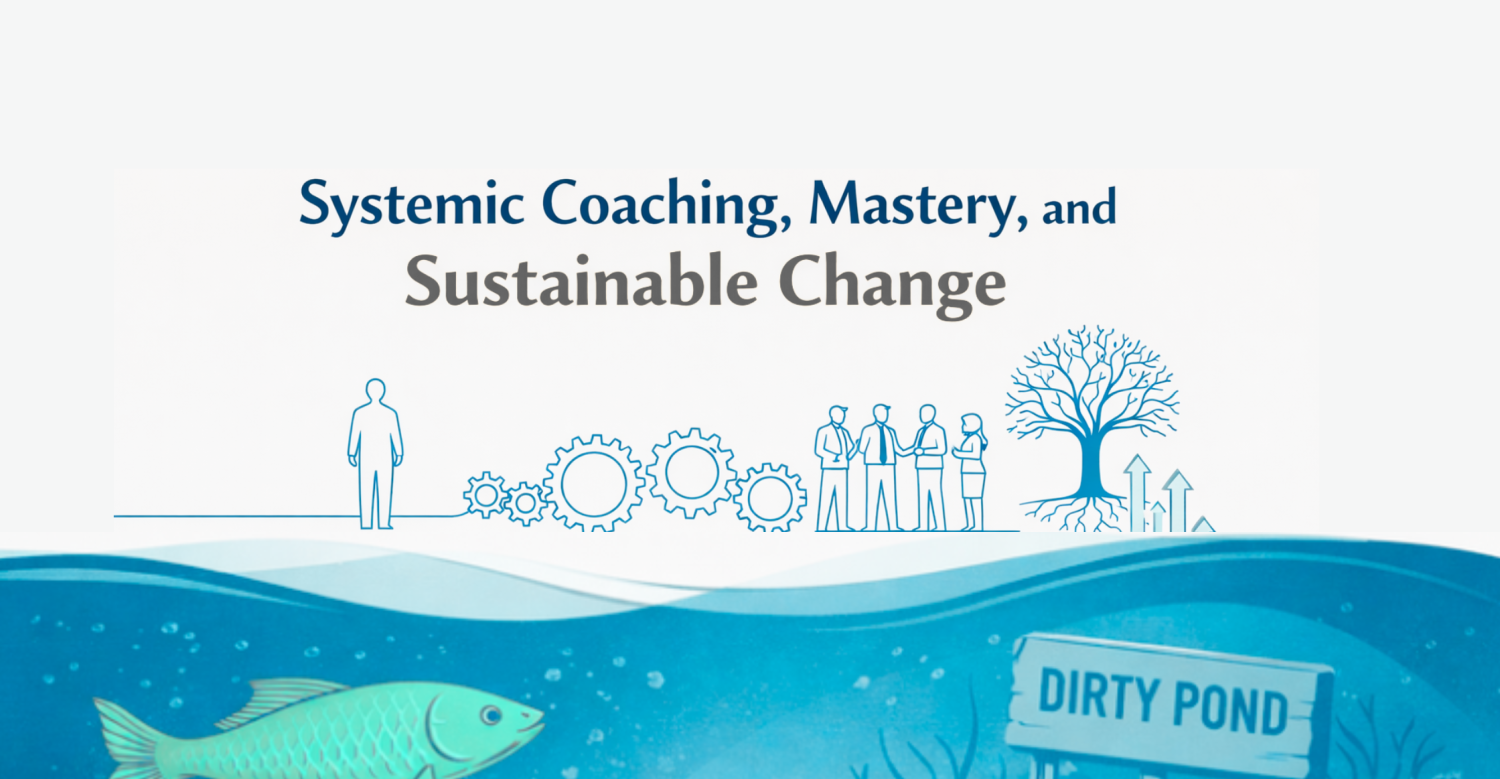
Clean Fish, Dirty Water: Why Change Doesn’t Stick
Creating sustainable change is rooted in ownership of change and experimenting with new behaviors.
I quote from an article I read:
“You might undertake fabulous efforts to improve leaders’ behavior on a particular dimension (cleaning the fish), but at the end of the day, they get put back in an environment full of the wrong cues (the dirty pond) … and the leader is stuck in the muck again.”
This metaphor captures a critical truth in leadership development and coaching.
So, What’s Missing Today?
Development thrives in a system of positiveness, grounded in the belief that people genuinely want to change. Stakeholders’ intentions and behaviors must align, and the organizational culture - the ways of working - must actively support such change.
What Is Systemic Coaching?
Coaching systemically is about:
“Looking beyond the immediacy of the one-to-one coaching relationship.”
Systemic coaching expands the lens from the individual to the entire system influencing behavior - relationships, culture, leadership, and environment.
How to Enable Coaching Systemically
1. Organizational Awareness
Organizations recognize that sustained change requires a supportive system in which it can thrive.
2. Agreement on Systemic Dialogue
Organizations commit to open, respectful, empathetic, and systemic dialogues with all stakeholders- internal and external.
3. Inclusion of the Immediate System
Organizations remain open to systemic conversations involving supervisors, peers, teams, and are willing to be coached themselves when needed.
4. Compassion for the Coachee’s Journey
Organizations acknowledge that change is difficult and actively support the coachee throughout their development journey.
5. Learning From the System
Organizations consciously learn from the system itself and commit to evolving it to create an environment where change can truly flourish.
6. Clarity of Stakeholder Roles
The organization, coach, and stakeholders share a common understanding of stakeholder roles, which include:
- Being a cheerleader
- Providing resources
- Believing in the coachee
- Remaining open to exploring what needs to change
7. Coach Capability in Systems Thinking
Coaches expand their understanding of systems, learn how to work with systems, and continue developing their systemic dialogue skills.
Closing Reflection
Sustainable development does not happen in isolation. Individual mastery matters - but systems determine whether change survives. Coaching that embraces the system creates the conditions where growth becomes possible, supported, and enduring.